
Secure EMI vs Traditional Loan Partners: A Smarter Choice for Merchants
For merchants, offering flexible payment options can make the difference between a customer completing a purchase and abandoning it. With eNACH and UPI Autopay mandates, businesses can offer structured EMI plans while making recurring collections easier to manage. But the bigger question is: should a merchant depend on a traditional loan partner, or choose a merchant-focused EMI platform such as Secure EMI?
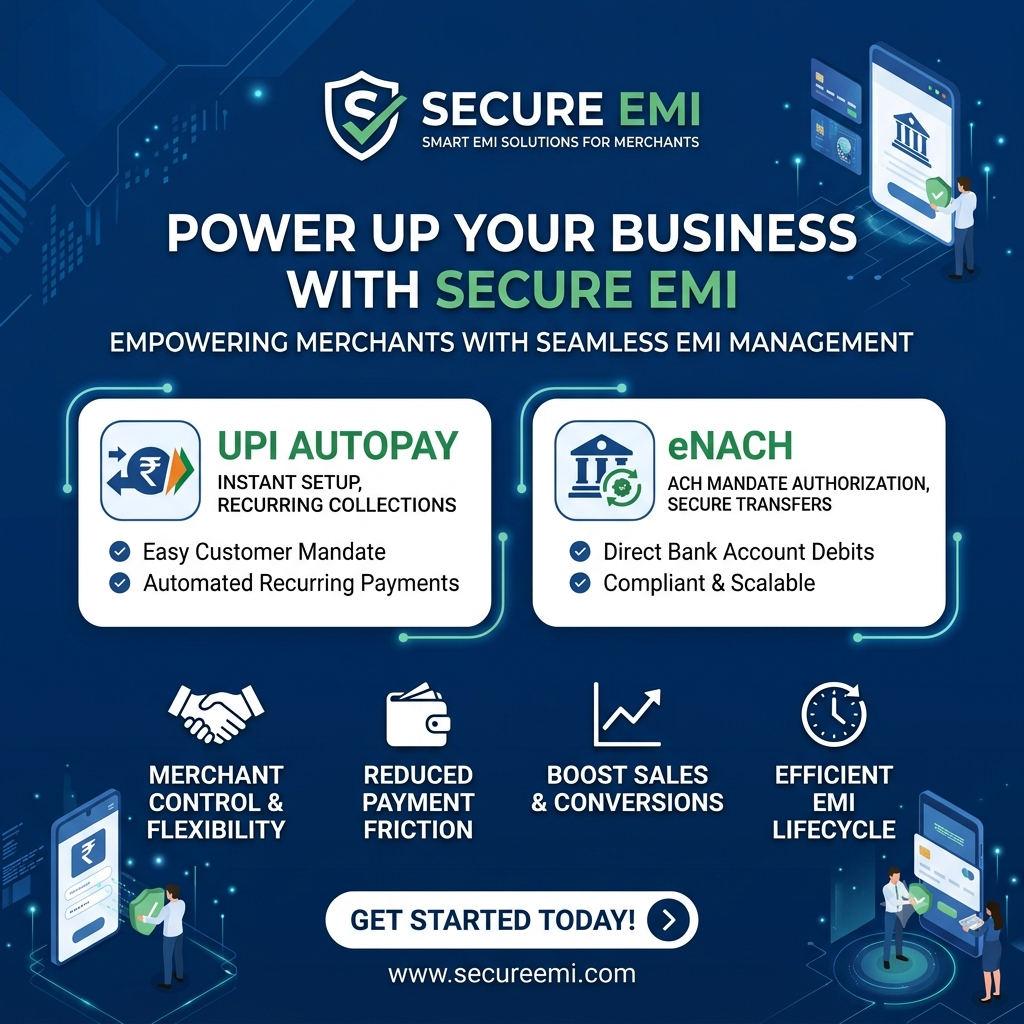
Traditional loan and bank-led EMI models can involve eligibility checks, credit-card dependencies, approval processes, fixed partner rules, and limited control over the customer experience. Secure EMI takes a different approach. Its merchant-funded EMI model gives businesses greater control over EMI plans while supporting automated collections through UPI Autopay and NACH.
For D2C brands, retailers, and SMEs, this approach can simplify the entire EMI lifecycle—from plan creation and customer authorization to recurring collections and merchant settlement.
Traditional Loan Partners vs. Merchant-Funded EMI
Traditional EMI financing generally works through a bank, NBFC, credit-card issuer, or lending partner. The merchant offers the financing option, but many important decisions remain with the financial institution.
The customer may need to meet specific eligibility criteria, complete additional checks, or use a particular financial product. The merchant may also have limited flexibility in deciding EMI structures.
A merchant-funded model changes this relationship.
With Secure EMI, the business can create an EMI plan according to its product pricing and customer strategy. Instead of depending entirely on a third-party lender's predefined EMI structure, the merchant can offer installment options designed around its own sales model.
This can be particularly useful for:
- Electronics and mobile retailers
- Furniture and appliance businesses
- D2C brands
- Education and training businesses
- Healthcare and wellness businesses
- Service-based SMEs
- High-ticket product sellers
The objective is simple: make the purchase more affordable for the customer while giving the merchant better control over the payment experience.
Why Traditional Loan Partners Can Create Friction
Traditional loan partnerships can be useful, but they may not always fit the needs of every merchant.
1. Dependence on External Approval
Loan-based EMI programs often depend on the lender's eligibility criteria and approval process. A customer who wants to purchase a product may not always qualify for the financing option available at checkout.
This can create friction at the most important stage of the sales journey.
2. Limited EMI Flexibility
Merchants may have to work within predefined tenures, pricing structures, and promotional conditions.
For a D2C business, this can make it difficult to create different EMI offers for different products or customer segments.
3. Credit Card Dependency
Some traditional EMI programs are closely associated with credit cards or specific lending products. This limits the number of customers who can use the option.
A merchant-focused solution can instead support automated bank-account-based collections through UPI Autopay and NACH.
4. More Complex Customer Journeys
Every additional approval, redirect, document requirement, or eligibility step can create drop-offs.
For merchants, the ideal EMI experience should be simple: select the plan, complete the required verification, authorize the payment method, and proceed with the purchase.
eNACH and UPI Autopay Mandates: A Better Collection Approach
One of the key advantages of modern merchant EMI infrastructure is automated recurring payment collection.
With eNACH mandate setup, customers authorize recurring deductions from their bank account according to the agreed EMI schedule. Similarly, UPI Autopay mandate setup allows customers to authorize recurring payments through supported UPI apps.
This removes the need for merchants to manually remind every customer about every installment.
Instead, the agreed payment schedule becomes part of the digital EMI process.
For businesses, this means fewer manual follow-ups, better payment visibility, and a more structured EMI collection process.
How to Set Up an eNACH Mandate
The how to set up eNACH mandate process can vary depending on the platform and payment flow, but the basic journey is straightforward:
- The merchant creates an EMI plan.
- The customer reviews and accepts the EMI terms.
- The customer provides the required information and authorization.
- An eNACH mandate is created through the supported payment infrastructure.
- Future EMI amounts are collected automatically according to the schedule.
This approach is especially useful when businesses want predictable recurring collections without relying on manual payment reminders.
How to Set Up UPI Autopay
For merchants exploring how to set up UPI Autopay, the process generally starts with creating the EMI plan and generating a customer authorization request.
The customer reviews the amount, frequency, and duration of the recurring payment and authorizes the mandate through their UPI-enabled application.
Once the mandate is successfully authorized, recurring EMI collections can be processed according to the agreed schedule.
This makes UPI Autopay particularly attractive for India's mobile-first customers.
How Secure EMI Works
Secure EMI is designed around the complete merchant EMI lifecycle rather than only the payment stage.
Step 1: Merchant Onboarding and KYC
The merchant completes the required onboarding and KYC process.
This creates the foundation for a structured and compliant EMI program.
Step 2: Create an EMI Plan
The merchant creates an EMI plan based on the product, purchase amount, tenure, and applicable commercial terms.
This provides more flexibility than simply displaying a lender-defined EMI option.
Step 3: Customer Authorization
The customer selects EMI and completes the required authorization process.
Depending on the payment flow, the customer can authorize recurring deductions using UPI Autopay or NACH.
Step 4: Automated EMI Collections
Once the mandate is active, scheduled EMI collections can be processed automatically.
The merchant does not need to manually collect each installment from every customer.
Step 5: Monitoring and Settlement
Merchants can monitor EMI status, upcoming payments, collections, and settlements through the platform.
This creates a centralized view of the EMI lifecycle.
Benefits of Choosing Secure EMI Over Traditional Loan Partners
The biggest advantage of Secure EMI is that it is built around the merchant's requirements.
Greater Control Over EMI Plans
Merchants can structure installment plans around their products and customer requirements instead of relying solely on predefined lender offerings.
No Traditional Bank or Credit Card Dependency
Secure EMI's merchant-funded model allows businesses to offer EMI without depending on traditional bank or credit-card-based EMI programs.
Automated Recurring Payments
UPI Autopay and NACH help automate recurring EMI collections, reducing the operational burden on merchant teams.
Better Customer Experience
Customers get a simple payment journey where they can purchase higher-value products and spread the payment across installments.
Reduced Manual Collection Work
Automated recurring payments can reduce repetitive follow-ups and help businesses organize their EMI collections more efficiently.
Better Visibility
A centralized platform helps merchants monitor EMI plans, payment status, collections, and settlements instead of managing the process across multiple systems.
Supports Business Growth
EMI can reduce the upfront price barrier and encourage customers to consider products they may otherwise postpone purchasing.
Real-Life Merchant Applications
The value of merchant EMI becomes clearer when we look at practical use cases.
Electronics and Mobile Retail
A mobile store selling smartphones priced at ₹25,000–₹60,000 may lose customers because of the upfront cost.
With merchant EMI, the store can offer installment plans and allow customers to authorize recurring payments through UPI Autopay or NACH.
This can make premium products more accessible without requiring a traditional credit-card EMI.
Secure EMI has also documented a mobile-store case study where a retailer reported significant sales growth after implementing a merchant-funded EMI solution.
D2C Brands
A D2C brand selling premium skincare, wellness products, furniture, electronics, or other high-value products can use EMI to reduce purchase hesitation.
Instead of immediately discounting a ₹20,000 product, the brand can make the purchase easier by offering a structured installment option.
This allows the brand to compete on affordability without necessarily reducing the product's headline price.
Furniture Businesses
Furniture purchases are often high-ticket transactions. Customers may like the product but hesitate because paying the complete amount upfront can be difficult.
EMI allows the merchant to convert that hesitation into a manageable payment schedule.
Education and Services
Businesses selling courses, professional training, memberships, or other high-value services can also benefit from installment-based payments.
Rather than losing a customer because of a large one-time payment, the business can offer a structured EMI plan with automated recurring collections.
Secure EMI vs. Traditional Loan Partners: Key Difference
| Factor | Traditional Loan Partner | Secure EMI |
|---|---|---|
| Business model | Lender/bank-led | Merchant-funded |
| Bank dependency | Usually involved | No traditional bank/credit-card dependency |
| EMI flexibility | Often lender-defined | Merchant-focused |
| Credit card dependency | May apply | Not required |
| Recurring collections | Supported depending on lender | UPI Autopay + NACH |
| Merchant control | Limited in many models | Greater control |
| Customer journey | May include lender approval | Merchant-centric EMI journey |
| EMI lifecycle | Shared across partners | Managed through one platform |
Business model
Traditional Loan Partner: Lender/bank-led
Secure EMI: Merchant-funded
Bank dependency
Traditional Loan Partner: Usually involved
Secure EMI: No traditional bank/credit-card dependency
EMI flexibility
Traditional Loan Partner: Often lender-defined
Secure EMI: Merchant-focused
Credit card dependency
Traditional Loan Partner: May apply
Secure EMI: Not required
Recurring collections
Traditional Loan Partner: Supported depending on lender
Secure EMI: UPI Autopay + NACH
Merchant control
Traditional Loan Partner: Limited in many models
Secure EMI: Greater control
Customer journey
Traditional Loan Partner: May include lender approval
Secure EMI: Merchant-centric EMI journey
EMI lifecycle
Traditional Loan Partner: Shared across partners
Secure EMI: Managed through one platform
The key difference is control.
Traditional loan partners primarily provide financing. Secure EMI is designed to help merchants manage an entire EMI offering—from plan creation to authorization, collections, and settlement.
Why eNACH and UPI Autopay Matter for Modern Merchants
Recurring payments are becoming increasingly important for businesses that want predictable collections.
The combination of eNACH and UPI Autopay mandates gives merchants two important mechanisms for automating scheduled payments.
eNACH can be useful for customers who prefer bank-account-based recurring instructions, while UPI Autopay provides a familiar mobile-first authorization experience.
For merchants, the benefit is not simply automation. It is operational consistency.
Instead of asking customers to remember every due date and manually initiating every payment, the mandate-based model connects authorization with the EMI schedule.
That can make EMI collections easier to track and manage at scale.
Secure EMI combines merchant-funded EMI with UPI Autopay and eNACH to give businesses greater control, flexible EMI options, and simpler recurring payment collection.”
Frequently Asked Questions
1. Does Secure EMI require customers to have a credit card?
No. Secure EMI supports UPI Autopay and NACH-based recurring collections, allowing customers to authorize EMI payments without depending on a traditional credit-card EMI program.
2. What is merchant-funded EMI?
Merchant-funded EMI is a model where the merchant offers installment-based payment options directly through an EMI platform instead of depending on a traditional bank or lender to provide the customer financing.
3. Can merchants customize EMI plans?
Yes. Secure EMI is designed to allow merchants to create EMI plans according to their business requirements, product pricing, and customer payment strategy.
4. What is the difference between eNACH and UPI Autopay?
Both can be used to authorize recurring payments, but they operate through different payment mechanisms. eNACH uses an electronic mandate through the NACH ecosystem, while UPI Autopay uses UPI-based recurring payment authorization.
5. Is EMI suitable for small businesses?
Yes. Merchant EMI can be useful for SMEs, retailers, D2C brands, and service providers selling products or services where customers may benefit from spreading payments over time.
Final Takeaway: Why Secure EMI Can Be a Better Merchant Choice
Traditional loan partners can play an important role in the financing ecosystem, but they are not always the best fit for businesses that want more control over their EMI experience.
Secure EMI takes a merchant-first approach.
Instead of making the merchant dependent on traditional bank or credit-card EMI structures, it provides a platform for creating merchant-funded EMI plans, onboarding customers, setting up recurring payment mandates, managing collections, and tracking settlements.
With UPI Autopay mandate setup, eNACH mandate setup, automated recurring payments, KYC-enabled onboarding, and a merchant-focused EMI lifecycle, businesses can make installment payments a practical part of their sales strategy.
For retailers, D2C businesses, and SMEs, the goal is simple: make high-value purchases easier for customers while making EMI management easier for the business.
Ready to Offer Smarter EMI Options?
If your business wants to increase conversions, make high-ticket products more affordable, and simplify recurring EMI collections, Secure EMI can help.
Contact Secure EMI to explore merchant-funded EMI, UPI Autopay, eNACH, and automated EMI collection solutions for your business.
Leave a Comment